
Posted by WatchPost Outfitters LLC. on Jul 12th 2026
Don’t Store Poison: The Best Water Storage Containers & Why All Water Isn't the Same
Part 1: The Best Water Storage Containers | Tested & Reviewed
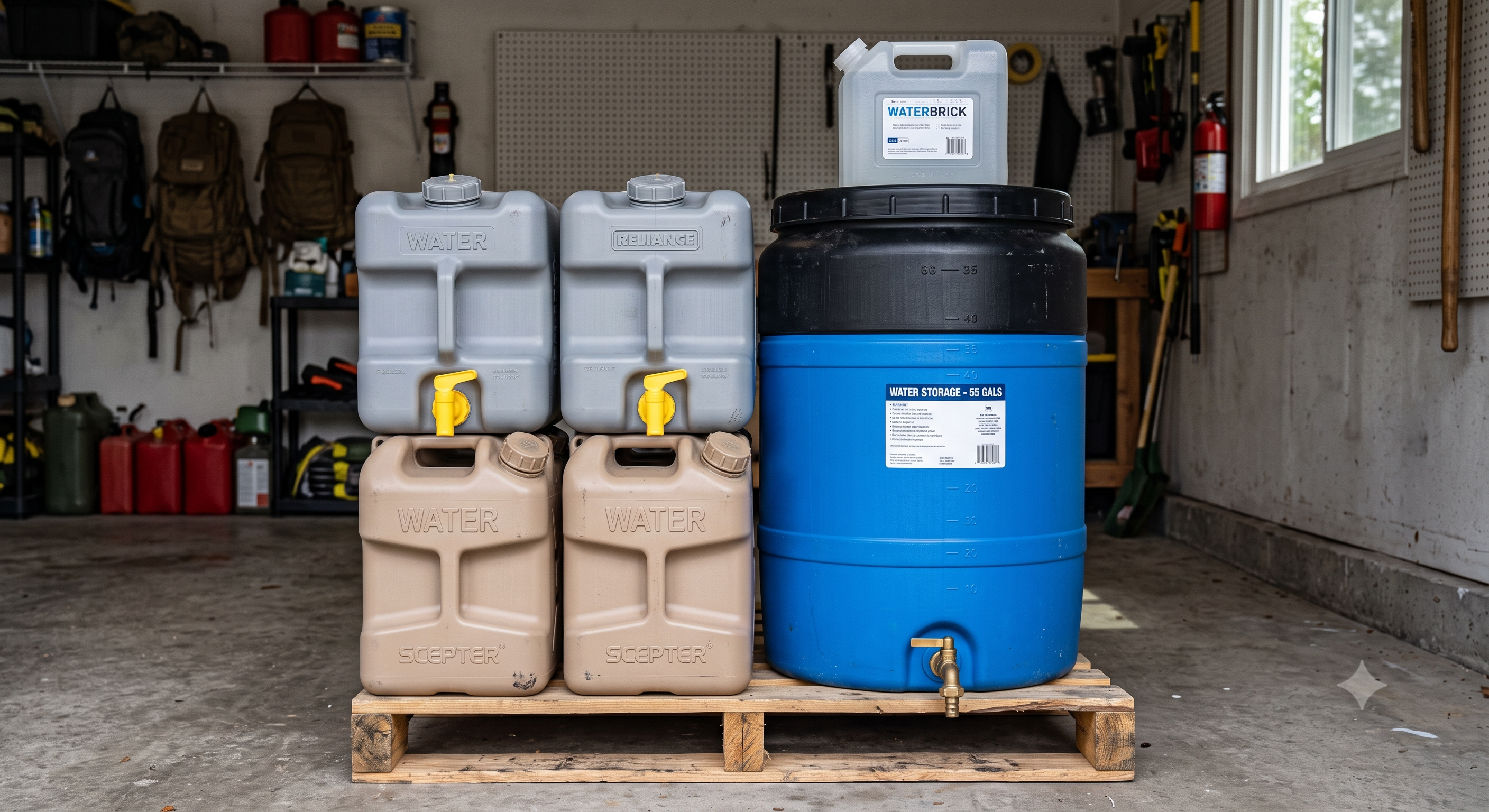
When evaluating water containers for survival, camping, and tactical scenarios, we analyze durability (wall thickness), pourability, transportability (weight when full), and spatial efficiency.
1. Best Overall: Scepter 5-Gallon Military Water Can (MWC)
-
Material: Heavy-duty, food-grade HDPE (BPA-free)
-
Weight (Full): ~46 lbs
-
Best For: Tactical, bug-out vehicles, rugged camping, and long-term home defense.
-
The Review: Originally designed for the military, the Scepter MWC is virtually indestructible. It features a massive 4-inch wide-mouth cap for easy cleaning and an integrated small pour-spout.
In drop tests, these cans can handle being thrown from a moving truck without bursting. The seamless construction means no weak weld lines to split under pressure. It also fits standard vehicle jerry-can mounts.
2. Best Budget & General Home Use: Reliance Aqua-Tainer (7-Gallon)
-
Material: Food-grade HDPE (BPA-free)
-
Weight (Full): ~60 lbs
-
Best For: Short-to-medium-term home emergencies (shelter-in-place).
-
The Review: At roughly $20, the Aqua-Tainer is the undisputed king of budget preparedness.
It features a rugged, boxy shape and a screw-on cap equipped with an adjustable on/off spigot that reverses into the container for storage. Warning: At 60 pounds full, it is heavy and awkward to carry for long distances. The plastic is thinner than military alternatives; accidental drops on concrete when full can cause cracking.
3. Best Middle Ground (Durability + Weight): Reliance Rhino-Pak (5.5-Gallon)
-
Material: Ultra-thick, food-grade HDPE
-
Weight (Full): ~48 lbs
-
Best For: Overlanding, base camps, and multi-week home storage.
-
The Review: If you want the toughness of a military can but the affordability of standard consumer gear, the Rhino-Pak is the sweet spot. It uses a much thicker plastic profile than the Aqua-Tainer, giving it excellent impact resistance. The 5.5-gallon capacity keeps the weight under 50 pounds, making it significantly easier to transport manually during a crisis.
4. Best Space-Saver & Modular Storage: Sagan Life AquaBrick / WaterBrick (3 to 3.5-Gallon)
-
Material: High-Density Polyethylene (HDPE)
-
Weight (Full): ~28–32 lbs
-
Best For: Apartments, tight closets, vehicular storage, and those with physical lifting limits.
-
The Review: These containers are designed like industrial Legos. They feature cross-locking indentations that allow you to stack them tightly up to 8 feet high, utilizing vertical space perfectly. Because they are smaller, they weigh roughly 30 pounds full—making them manageable for everyone in a household to carry. They also feature robust, secure handles and can dual-purpose as dry food storage blocks.
5. Best Instant-Onset Disaster Solution: WaterBOB Bathtub Storage Bladder
-
Material: 10-mil food-grade LLDPE
-
Capacity: Up to 100 gallons
-
Best For: Hurricanes, severe winter storms, or civil unrest with 24-hour advance warning.
-
The Review: The WaterBOB is a single-use bladder meant to be laid out inside your standard bathtub and filled from the tap right before a disaster hits (e.g., before the water grid loses pressure or becomes contaminated).
It keeps up to 100 gallons of water fresh and protected from soap scum, dust, and debris for up to 16 weeks. It includes a siphon hand pump for easy dispensing.
Part 2: Is All Water the Same for Storage Situations?
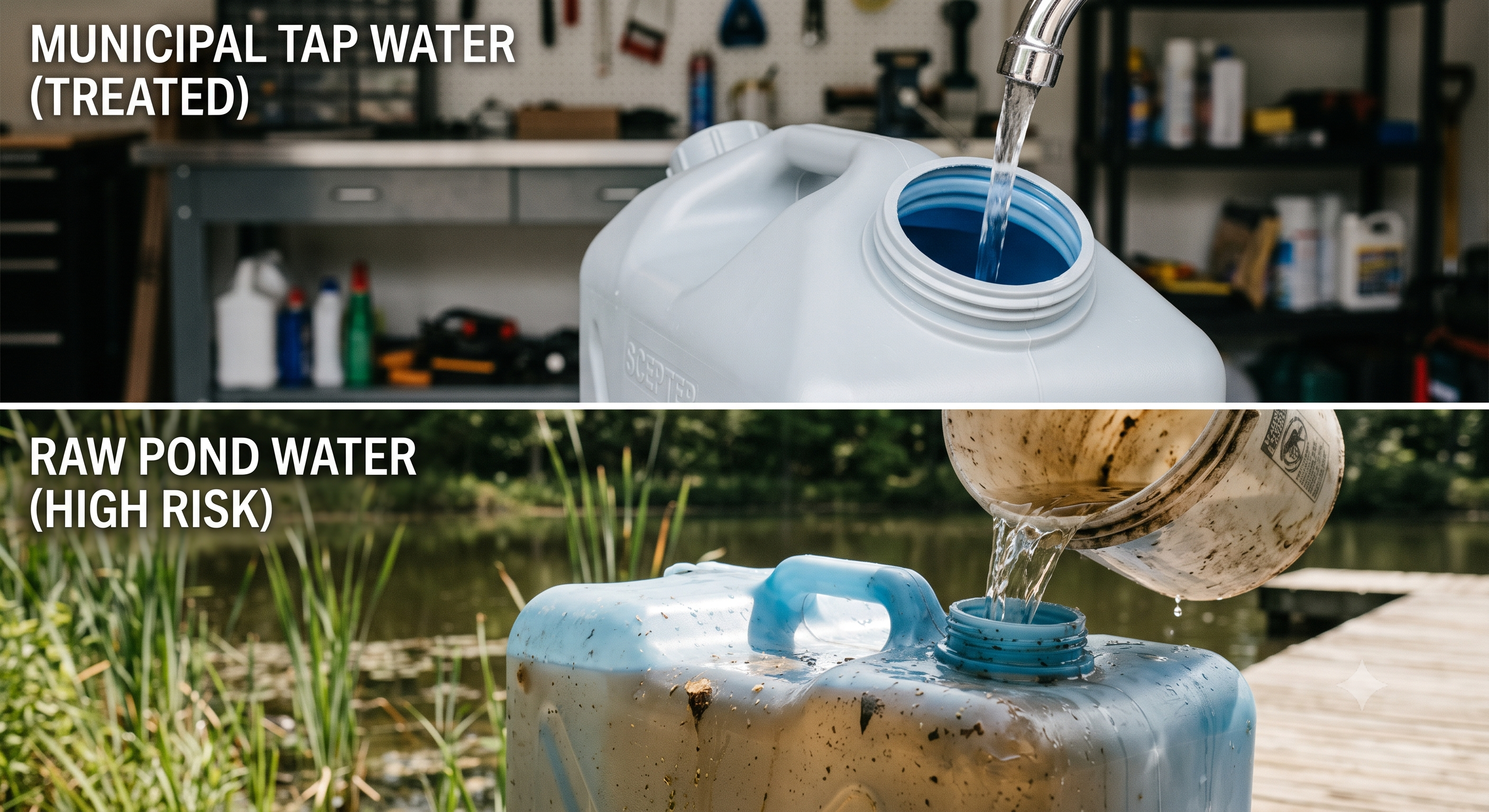
Absolutely not. One of the most dangerous mistakes a prepper can make is assuming that any clear water poured into a jug will remain safe to drink indefinitely. Water stability is entirely dependent on its source, its biological footprint, and its chemical composition.
Here is how different water types behave in a closed-container storage environment:
1. Municipal Tap Water (The Long-Term Baseline)
-
Characteristics: Treated with chlorine or chloramines.
-
Storage Viability: Excellent.
-
The Breakdown: If you draw water from a modern municipal grid, it is already chemically sanitized.
When sealed in a clean, opaque HDPE container, tap water can easily stay safe for 1 to 2 years without any additional treatment. Over time, the chlorine gas will dissipate into the small pocket of air at the top of the container, and the water might taste "flat" (due to a loss of dissolved oxygen), but it remains biologically safe.
2. Well Water & Natural Springs (The Clean But Vulnerable Option)
-
Characteristics: High in natural minerals, zero municipal chemical additives.
-
Storage Viability: Moderate (Requires immediate treatment).
-
The Breakdown: While well water tastes great fresh, it lacks residual sanitizers. Even deep well water contains microscopic, dormant spores of algae or bacteria. If stored raw in a plastic container exposed to even minor ambient light or warmth, those micro-organisms will rapidly multiply, turning your emergency supply into a science experiment. Well water must be treated with unscented liquid bleach or a dedicated chlorine dioxide water preserver before long-term storage.
3. Filtered Water (RO, Berkey, or Distilled)
-
Characteristics: Stripped of minerals, chemicals, and microbes.
-
Storage Viability: High Risk (Counter-Intuitive).
-
The Breakdown: Many people assume Reverse Osmosis (RO) or distilled water is perfect for storage because it is "pure." However, pure water lacks the protective residual chlorine of tap water. The moment it comes into contact with the air or the inside of your container, it is highly susceptible to biological cross-contamination. Furthermore, distilled water is chemically "hungry"; because it lacks minerals, it is aggressive and can more readily leach chemical compounds or a heavy "plastic taste" from lower-quality containers over time.
4. Surface Water (Lakes, Rivers, Rainwater)
-
Characteristics: High organic matter, biological contaminants, potential chemical runoff.
-
Storage Viability: Do Not Store Long-Term Raw.
-
The Breakdown: Surface water should only be collected in an active emergency. Storing it long-term is highly inefficient because the suspended organic materials will decay, consuming any chemical treatment you add and causing massive bacterial blooms. If you must harvest rainwater or river water, filter it down to the sub-micron level to remove organic matter before placing it into a sanitized storage container.
Critical Water Storage Protocols
-
The Golden Rule of Plastics: Only store water in Food-Grade, BPA-free plastics—specifically Plastic #2 (HDPE) or Plastic #4 (LDPE). Never use old milk jugs. Milk jugs are biodegradable and designed to break down rapidly; they will turn brittle and leak from the seams within months.
-
The Bleach Ratio: If treating raw or questionable water for storage, use 8 drops of regular, unscented 6%–8.25% household bleach per gallon of water (or roughly $\frac{1}{2}$ teaspoon per 5 gallons). Let it sit for 30 minutes. You should detect a very faint chlorine smell; if you don't, repeat the dose and let it sit for another 15 minutes.
-
Environmental Factors: Store your containers completely out of direct sunlight and off raw concrete floors.
Concrete can transfer heat and volatile chemical vapors directly into the bottom of plastic jugs over time. Place a wooden pallet or heavy cardboard underneath your water blocks.